Buttweld Cross Manufacturer, Supplier & Exporter
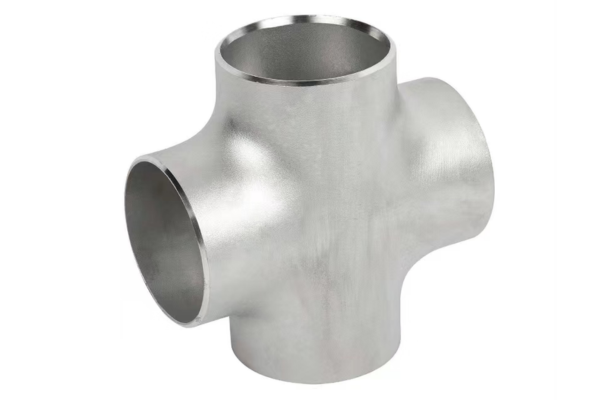
A buttweld cross is a four-way fitting with two run ends and two opposite branches, all at 90° to each other. Raaj Fittings manufactures and exports equal and reducing crosses to ASME B16.9 in stainless steel, duplex and super duplex, nickel alloys, carbon steel and alloy steel, in seamless and welded construction.
A cross lets two branches leave a main line at exactly the same point, which saves space compared with two tees placed one after the other. It is used in fire water and sprinkler networks, in distribution manifolds, and wherever a compact four-way junction is needed.
Every cross is bevelled for butt welding to the pipe schedule and supplied with EN 10204 3.1 mill test certificates, with 3.2 certification on request.
We export buttweld crosses to EPC contractors, refineries and stockists across the Middle East and GCC, Europe and the Americas — to ASME B16.9 for US and Gulf projects, or EN 10253 / DIN dimensions for European specifications, with PED-compliant supply on request.
Cross Specifications
½" NPS to 24" NPS; larger sizes to order
Equal (straight) cross and reducing cross (run × run × branch × branch)
SCH 5S to XXS, including STD, XS, SCH 40, 80 and 160
Seamless (hot-formed) and welded
Bevelled ends for butt welding to ASME B16.25
EN 10204 3.1 mill test certificate as standard; EN 10204 3.2 on request
Materials & Grades
We supply buttweld crosses in the following materials and grades. All grades are supplied with EN 10204 3.1 / 3.2 Mill Test Certificates.
Stainless Steel Buttweld Crosses
Stainless steel buttweld fittings deliver excellent corrosion resistance and are essential in chemical, pharmaceutical, food processing, and marine environments. All grades supplied to ASTM A403 specification.
(ASTM A403 WP304 / WP304L) General corrosion resistance; food, dairy, and chemical service
(ASTM A403 WP316 / WP316L) Enhanced chloride and acid resistance; pharmaceutical, marine, and chemical processing
(ASTM A403 WP316H) Elevated-temperature creep strength for high-temperature process service
(ASTM A403 WP317 / WP317L) Higher molybdenum content; superior corrosion resistance in concentrated acid service
(ASTM A403 WP321) Titanium-stabilised; resists sensitisation at sustained elevated temperatures
(ASTM A403 WP347) Columbium-stabilised; ideal for heat exchangers and high-temperature piping
High-alloy austenitic; superior resistance to hot concentrated sulfuric and phosphoric acids
Duplex & Super Duplex Stainless Steel Buttweld Crosses
Duplex and super duplex grades offer approximately twice the yield strength of standard austenitic stainless steel, combined with excellent resistance to stress corrosion cracking and pitting — ideal for offshore, subsea, and chemical processing environments.
(UNS S31803 / S32205) Offshore topsides, chemical plant, desalination, and seawater piping
(UNS S32750) Seawater systems, subsea equipment, FPSOs, and high-chloride offshore environments
(UNS S32760) High-temperature, high-chloride offshore and subsea service applications
Nickel Alloy Buttweld Crosses
For the most aggressive corrosive environments — concentrated acids, caustic solutions, sour gas service, and extreme temperatures — we offer buttweld fittings in a full range of nickel alloys.
(UNS N06600) High-temperature oxidation and carburisation resistance
(UNS N06625) Outstanding broad-spectrum corrosion resistance; offshore, chemical, and subsea service
(UNS N08825) Resistance to phosphoric and sulfuric acids; FGD systems and chemical plant
(UNS N10276) Universal corrosion resistance across the widest range of aggressive process media
(UNS N06022) Superior resistance to oxidising and reducing acids and pitting attack
(UNS N04400) Suitable for seawater, hydrofluoric acid, and marine and alkali service
(UNS N08020) Engineered for sulfuric acid and aggressive chemical process service
Exceptional corrosion resistance in seawater and oxidising media at low density
(C70600 / C71500) Preferred for marine seawater piping and naval condenser systems
Carbon Steel Buttweld Crosses
Carbon steel is the most widely specified material for general-purpose, hydrocarbon, and elevated-temperature service. The primary grade is ASTM A234 WPB for standard service. For high-yield pipeline fittings, we supply ASTM A860 WPHY grades to MSS SP-75.
Standard carbon steel; primary grade for general-purpose process piping buttweld fittings
Impact-tested carbon steel for low-temperature service down to -46°C (-50°F); LNG and cryogenic piping
High-yield pipeline fittings to MSS SP-75; used in high-pressure oil, gas, and liquid transmission pipelines
Alloy Steel Buttweld Crosses
Chromium-molybdenum alloy steel buttweld fittings are specified for high-temperature, high-pressure service in power generation, petrochemical, and refinery applications. All grades supplied to ASTM A234 specification.
(5% Cr · ½% Mo) Refinery high-temperature service; hydrotreating and catalytic reforming units
(9% Cr · 1% Mo) High-temperature hydrogen-rich process service and steam piping
(1¼% Cr · ½% Mo) Thermal power plant steam, feedwater, and reheat piping
(2¼% Cr · 1% Mo) Reactors and high-temperature pressure piping systems in petrochemical plants
(9% Cr · 1% Mo · V · Nb) Ultra-supercritical steam power plant main steam and hot reheat piping
When to Use a Cross
A cross joins four pipes at one point. All four centre-to-end dimensions of an equal cross are the same and match those of an equal tee of the same size, so a cross can replace a tee in a layout without moving the run.
- Compact junctions — two branches from one point instead of two separate tees.
- Fire water and sprinklers — common at ring-main junctions and hydrant connections.
- Manifolds — distribution and collection manifolds with opposed branches.
- Reducing crosses — smaller branches without separate reducers.
Design Considerations
At a cross, flows from four directions meet at one point, so the junction sees more turbulence and higher stress than a tee. Many process piping specifications prefer two offset tees for hot, high-pressure or cyclic lines, and reserve crosses for utility and fire water service or where space demands it. Check that your piping specification permits crosses before using them in process service.
Alternatives
For a single branch, use an equal tee or a reducing tee. Where the branch should join at an angle to reduce turbulence, a lateral tee is used. For small-bore lines, see the forged cross.
Applications & Industries
- Fire water ring mains, hydrant and deluge systems
- Utility water, air and inert gas distribution manifolds
- Cooling water networks in power and process plants
- Offshore utility and seawater systems
- Water treatment and irrigation networks
In fire protection networks, crosses allow hydrant, monitor and deluge connections to leave the ring main at one point, which keeps valve pits and supports compact. In utility manifolds they simplify the layout of opposed headers. Where the cross carries corrosive water or seawater, duplex, super duplex and copper-nickel grades give a long service life with low maintenance.
Explore the full range of buttweld fittings.
Testing, Inspection, Marking & Packing
Crosses are made under our quality assurance process:
- Incoming material verification with PMI testing
- Chemical and mechanical testing to the applicable ASTM specification
- Heat treatment after forming as required by the grade
- Radiographic or ultrasonic examination of weld seams on welded crosses
- Dimensional inspection of all four centre-to-end dimensions, outside diameters, wall thickness and bevels
- Marking with grade, size, schedule and heat number
Supplied with EN 10204 3.1 mill test certificates; EN 10204 3.2 certificates and third-party inspection are available on request.
Fittings are packed for export with plastic end caps protecting the bevels, rust-preventive or VCI wrapping on carbon and alloy steel, and seaworthy wooden cases; marking, tagging and packing to your specification are available on request.
Why Choose Raaj Fittings for Buttweld Crosses?
Raaj Sagar Steels has supplied piping components since 2003 and today manufactures buttweld fittings at two plants in India for buyers in the Middle East, Europe and the Americas.
- Manufactured in-house — Buttweld crosses are made in our own plants, so material, dimensions and delivery stay under our control.
- Ready stock, short lead times — common sizes and grades are held in stock for prompt dispatch; other sizes, grades and specials are manufactured to order.
- Certified quality — ISO 9001:2015, ISO 14001:2015 and ISO 45001:2018 certified; PED 2014/68/EU and IBR supply available, and NACE MR0175 / ISO 15156 material on request.
- 100% material verification — PMI testing on incoming material and EN 10204 3.1 mill test certificates with every order; 3.2 certificates on request.
- Third-party inspection ready — we regularly work with SGS, Bureau Veritas, TÜV and DNV.
- Export documentation — MTCs, certificates of origin, packing lists and inspection reports to suit projects in the GCC, Europe and the Americas.
- Export packing — seaworthy packing with end and face protection, and packing to your specification on request.
- Fast response — our team replies to enquiries within one business day.
Buttweld Crosses — FAQs
A buttweld cross is a four-way fitting with two run ends and two opposite branches at 90°. It joins four pipes at one point.
A tee has one branch; a cross has two opposite branches. An equal cross has the same centre-to-end dimensions as an equal tee of the same size.
Mostly in fire water, sprinkler, utility and cooling water systems, and in manifolds where two branches must leave the same point.
The junction has higher stress and turbulence than a tee, so many process specifications prefer two offset tees for hot, high-pressure or cyclic lines. Check your piping specification.
Yes. Reducing crosses have branches smaller than the run, so separate reducers are not needed on the branches.
Yes. We supply buttweld crosses for projects under the European Pressure Equipment Directive (PED 2014/68/EU), and with IBR certification for Indian boiler applications. NACE MR0175 / ISO 15156 compliant material is also available on request for sour service in the Middle East and the Americas.