Threaded Flange Manufacturer, Supplier & Exporter
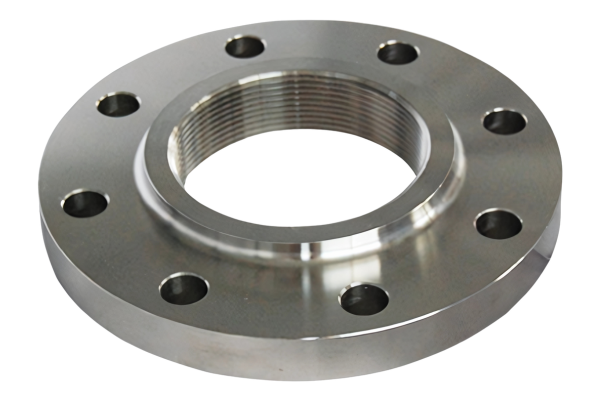
A threaded flange (TF), also called a screwed flange, has a tapered internal thread in its bore and is screwed onto a pipe with a matching external thread — no welding is needed. Raaj Fittings manufactures and exports threaded flanges to ASME B16.5 in stainless steel, duplex, nickel alloys, carbon steel and alloy steel, with NPT or BSPT threads.
Threaded flanges are chosen where welding is impractical or not permitted — in areas with fire or explosion risk, on galvanised pipe that would be damaged by welding, and for quick installation on small-bore utility lines. They are normally used on smaller sizes and at moderate pressures and temperatures.
Each flange is supplied with EN 10204 3.1 mill test certificates, with 3.2 certification and third-party inspection available on request.
We export threaded flanges to EPC contractors, refineries and stockists across the Middle East and GCC, Europe and the Americas, made to the ASME, EN or DIN standard your project specifies, with PED-compliant supply for European projects on request.
Threaded Flange Specifications
½" NPS to 24" NPS to ASME B16.5; most commonly used up to 4" NPS
ASME Class 150, 300, 600, 900, 1500 and 2500 (size limits apply in the higher classes)
ASME B16.5; EN 1092-1 Type 13 and other standards on request
NPT to ASME B1.20.1; BSPT to BS 21 / ISO 7-1
Forged, heat treated as required, CNC machined and thread-gauged
EN 10204 3.1 mill test certificate as standard; EN 10204 3.2 on request
Materials & Grades
We supply threaded flanges in the following materials and grades. All grades are supplied with EN 10204 3.1 / 3.2 Mill Test Certificates.
Stainless Steel Threaded Flanges
Stainless steel flanges offer excellent corrosion resistance and are essential in chemical, pharmaceutical, food processing, and marine environments.
(ASTM A182 F304 / F304L) General corrosion resistance
(ASTM A182 F316 / F316L) Superior resistance to chlorides, acids; marine & pharmaceutical service
(ASTM A182 F316H) High-temperature elevated creep strength
(ASTM A182 F321) Titanium-stabilized; suitable for sustained elevated temperatures
(ASTM A182 F347) Columbium-stabilized; used in heat exchangers and high-temperature piping
High alloy; exceptional resistance to strong acids
Duplex & Super Duplex Stainless Steel Threaded Flanges
Duplex and super duplex grades offer approximately twice the yield strength of standard austenitic stainless steel, combined with excellent resistance to stress corrosion cracking and pitting — making them ideal for offshore, subsea, and chemical processing.
(UNS S31803 / S32205) Used in offshore platforms and chemical processing plants
(UNS S32750) Ideal for seawater handling and desalination systems
(UNS S32760) Designed for high-chloride offshore service applications
Nickel Alloy Threaded Flanges
For the most aggressive corrosive environments — including concentrated acids, caustic solutions, sour gas service, and extreme temperatures — we offer flanges in a full range of nickel alloys.
(UNS N06600) High-temperature oxidation resistance
(UNS N06625) Outstanding corrosion resistance for offshore and subsea service
(UNS N08825) Excellent resistance to phosphoric and sulfuric acids
(UNS N10276) Broad-spectrum corrosion resistance in acids and chlorides
(UNS N06022) Superior resistance to oxidizing acids
(UNS N04400) Suitable for seawater, hydrofluoric acid, and marine environments
(UNS N08020) Engineered for sulfuric acid service
Exceptional corrosion resistance with low weight
(C70600 / C71500) Preferred for marine and seawater piping systems
Carbon Steel Threaded Flanges
Carbon steel is the standard choice for general-purpose, non-corrosive, and elevated-temperature services. The primary grade for forged carbon steel flanges is ASTM A105, and for low-temperature service, ASTM A350 LF2.
Primary grade for forged carbon steel fittings and flanges — covers ambient and elevated-temperature service in pressurised piping systems.
Low-temperature carbon steel, impact-tested for service down to -46°C (-50°F) — LNG, cold climate, and cryogenic piping applications.
Alloy Steel Threaded Flanges
Alloy steel flanges are specified for high-temperature, high-pressure service in power generation, petrochemical, and refinery applications.
(5% Cr, ½% Mo) Designed for elevated temperature refinery service
(9% Cr, 1% Mo) Suitable for high-temperature steam and hydrogen service
(1¼% Cr, ½% Mo) Widely used in thermal power plant piping systems
(2¼% Cr, 1% Mo) Used in high-temperature pressure vessels and reactors
(9% Cr, 1% Mo, V, Nb) Engineered for ultra-high-temperature power plant steam lines
When to Use a Threaded Flange
The threaded flange makes a bolted joint on a pipe without any hot work. The tapered pipe thread tightens as it is screwed on, and a suitable thread sealant or tape completes the seal. Threaded flanges are especially useful where a permit for welding is difficult to obtain, or where the pipe material cannot easily be welded.
- No welding — safe to install in hazardous areas and on live plants.
- Fast installation — no welder, weld inspection or post-weld treatment needed.
- Galvanised pipe — joins galvanised water and fire-fighting pipe without burning off the coating.
- Removable — the flange can be unscrewed if the line is modified.
Limitations
Threads cut into the pipe reduce its effective wall thickness, and threaded joints can leak under thermal cycling, vibration or bending loads. Threaded flanges are therefore not recommended for high-temperature, cyclic or hazardous-fluid service. Where extra security is needed, the joint can be seal-welded after make-up. For small-bore lines that can be welded, a socket weld flange is stronger, and for low-pressure welded lines a slip on flange is economical.
NPT or BSPT?
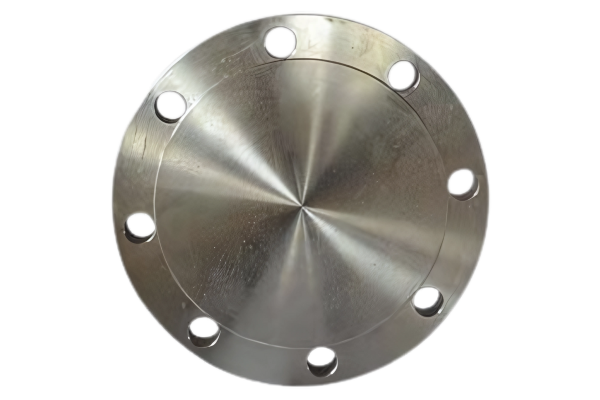
NPT (ASME B1.20.1) has a 60° thread form and is standard in the Americas and on most international oil and gas projects. BSPT (BS 21 / ISO 7-1) has a 55° thread form and is common in Europe, the Middle East and Asia. The two are not interchangeable, so always state the thread type when ordering. Unused flanged outlets can be closed with a blind flange.
Applications & Industries
- Fire water and sprinkler systems, including galvanised pipe
- Utility water, compressed air and inert gas lines
- Small-bore connections in hazardous areas where hot work is restricted
- Instrument and analyser connections
- Low-pressure process and drainage lines
- Skid-mounted packages and temporary installations
See all flange types, or our forged threaded fittings for the rest of a screwed piping system.
Testing, Inspection, Marking & Packing
Threaded flanges are produced under our quality assurance process:
- Incoming material verification with PMI testing
- Chemical and mechanical testing to the applicable ASTM material specification
- Thread inspection with NPT or BSPT ring and plug gauges
- Dimensional inspection of outside diameter, bolt circle, hub and facing
- Marking with grade, size, class, thread type and heat number
Supplied with EN 10204 3.1 mill test certificates; EN 10204 3.2 certificates and third-party inspection are available on request.
Flanges are packed for export with gasket faces protected by covers, rust-preventive coating on carbon and alloy steel, and seaworthy wooden cases; marking, tagging and packing to your specification are available on request.
Why Choose Raaj Fittings for Threaded Flanges?
Raaj Sagar Steels has supplied piping components since 2003 and today manufactures flanges at two plants in India for buyers in the Middle East, Europe and the Americas.
- Manufactured in-house — Threaded flanges are made in our own plants, so material, dimensions and delivery stay under our control.
- Ready stock, short lead times — common sizes and grades are held in stock for prompt dispatch; other sizes, grades and specials are manufactured to order.
- Certified quality — ISO 9001:2015, ISO 14001:2015 and ISO 45001:2018 certified; PED 2014/68/EU and IBR supply available, and NACE MR0175 / ISO 15156 material on request.
- 100% material verification — PMI testing on incoming material and EN 10204 3.1 mill test certificates with every order; 3.2 certificates on request.
- Third-party inspection ready — we regularly work with SGS, Bureau Veritas, TÜV and DNV.
- Export documentation — MTCs, certificates of origin, packing lists and inspection reports to suit projects in the GCC, Europe and the Americas.
- Export packing — seaworthy packing with end and face protection, and packing to your specification on request.
- Fast response — our team replies to enquiries within one business day.
Threaded Flanges — FAQs
A threaded flange has a tapered internal thread in its bore and screws onto a pipe with a matching external thread. It forms a bolted flange joint without any welding.
They are used where welding is impractical or not allowed — in hazardous areas, on galvanised fire and water pipe, and for small-bore utility and instrument lines. They suit moderate pressures and temperatures.
They are available up to Class 2500 in smaller sizes, but threaded joints are sensitive to thermal cycling, vibration and bending. For high-temperature or cyclic service a weld neck or socket weld flange is preferred, or the threaded joint is seal-welded.
NPT threads to ASME B1.20.1 are standard. BSPT threads to BS 21 / ISO 7-1 are supplied for projects that specify BSP. State the thread type when ordering, as the two are not interchangeable.
Seal welding is a small fillet weld made around the joint between a threaded flange and the pipe after the thread has been tightened. It provides extra leak tightness but is not counted on for strength.
Yes. We supply threaded flanges for projects under the European Pressure Equipment Directive (PED 2014/68/EU), and with IBR certification for Indian boiler applications. NACE MR0175 / ISO 15156 compliant material is also available on request for sour service in the Middle East and the Americas.