Tube Union Elbow Manufacturer, Supplier & Exporter
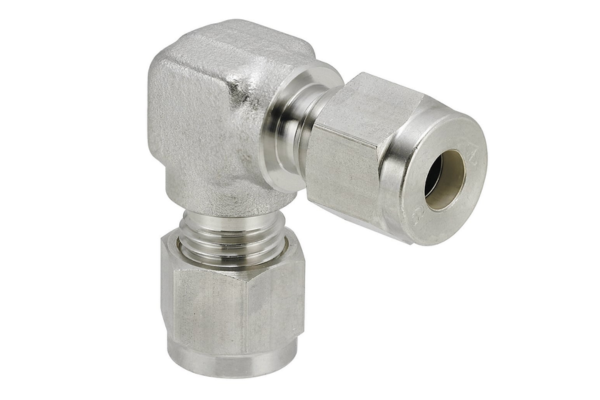
A union elbow joins two tubes of the same outside diameter at a 90° angle, with a compression end on each leg. Raaj Fittings manufactures and exports union elbows in double ferrule, single ferrule and DIN 2353 bite type designs, in SS 316L, SS 304, duplex, super duplex, carbon steel and nickel alloys, in all standard metric and imperial tube sizes.
Union elbows change the direction of a tubing run where the tube cannot be bent — in tight spaces, close to equipment, or where a bend would need too small a radius. They also create a break point so that a section of tubing can be removed for maintenance.
All union elbows are supplied with EN 10204 3.1 mill test certificates and full material traceability.
We export union elbows to instrumentation contractors, OEMs and distributors across the Middle East and GCC, Europe and the Americas, in metric and imperial tube sizes with NPT or BSP ends to suit each market.
Union Elbow Specifications
Metric 3–25 mm (4–42 mm in DIN 2353); imperial 1/8"–1"
90°
Double ferrule, single ferrule and DIN 2353 / ISO 8434-1 bite type
Double ferrule up to 413 bar; single ferrule up to 207 bar; DIN 2353 L series 250 bar, S series 400 bar
Forged or machined body with equal compression ends
Precision-machined; forged bodies for larger sizes
EN 10204 3.1 mill test certificate; EN 10204 3.2 on request
Materials & Grades
We supply union elbows in the following materials and grades. All grades are supplied with EN 10204 3.1 / 3.2 Mill Test Certificates.
Stainless Steel Union Elbows
Stainless steel is the standard material for instrumentation tube fittings across oil and gas, petrochemical, pharmaceutical, and offshore applications. SS 316L is the most widely specified grade.
The industry default for instrumentation tube fittings — low carbon content prevents sensitisation; molybdenum addition provides superior chloride and acid resistance versus 304 grades.
Superior chloride and acid resistance — used where chloride exposure, marine atmosphere, or mild chemical service requires better corrosion resistance than 304.
General corrosion resistance at lower cost than 316L — suitable for water, steam, mild chemical, and food-grade applications where chloride exposure is limited.
Duplex & Super Duplex Stainless Steel Union Elbows
Duplex and super duplex grades provide approximately twice the yield strength of 316L with excellent resistance to chloride stress corrosion cracking — the preferred choice for offshore and subsea instrumentation where standard 316L may be susceptible to SCC.
(UNS S31803 / S32205) Offshore topsides instrumentation, seawater injection, and chemical injection systems
(UNS S32750) Subsea instrumentation, high-chloride offshore service, and FPSOs — PREN ≥ 42
Nickel Alloy Union Elbows
For aggressive chemical, sour gas, and high-temperature service where duplex stainless steel is insufficient — specified in chemical injection, downhole instrumentation, and severe process environments.
(UNS N06625) Outstanding corrosion resistance in offshore, subsea, and chemical service; widely specified for downhole instrumentation and subsea chemical injection tubing
(UNS N10276) Broad-spectrum resistance to aggressive acids, chlorides, and oxidising media; chemical and FGD process sample systems
(UNS N04400) Hydrofluoric acid service, seawater, and marine instrumentation systems
(UNS N08020) Sulfuric acid and aggressive chemical process sample and instrumentation systems
Carbon Steel Union Elbows
Carbon steel tube fittings are used in hydraulic systems, compressed air, general industrial service, and non-corrosive process applications where stainless steel is not required.
Precision-machined carbon steel bar stock — used in hydraulic circuits, compressed air distribution, and general industrial instrumentation where corrosion resistance is not required.
Electroplated zinc or phosphated finish for enhanced surface corrosion protection — used in carbon steel DIN 2353 hydraulic fittings and general instrumentation in non-aggressive environments.
Union Elbow or Tube Bend?
Bending the tube itself is often the neatest way to change direction, with no extra joints. But bends need a minimum radius and straight lengths either side, and they are not always practical. A union elbow gives a sharp 90° turn in very little space and is used where:
- Space is tight — at equipment connections and inside panels and enclosures.
- Tube is heavy-wall — larger or thicker tubes that are hard to bend.
- A break is needed — so a section can be removed for maintenance.
- Bends would be too tight — where the radius would be below the tube’s minimum.
Related Shapes
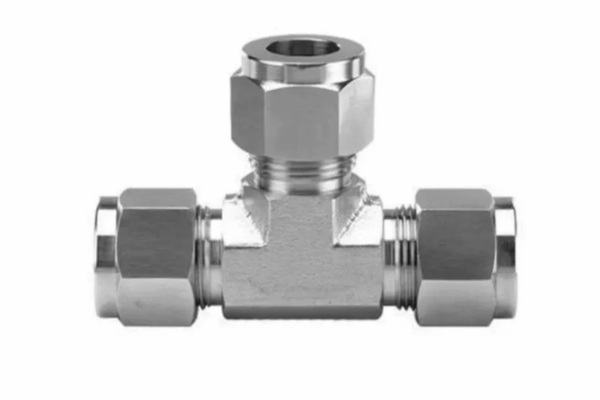
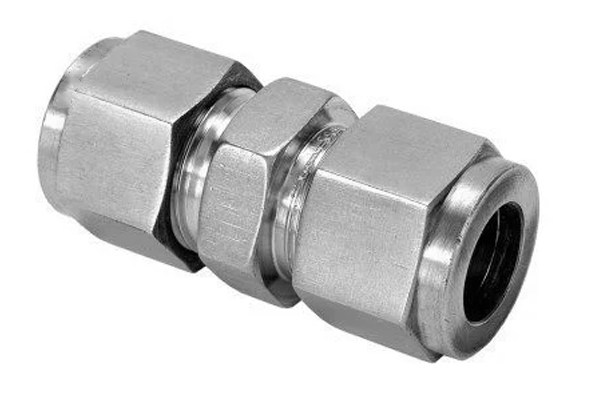
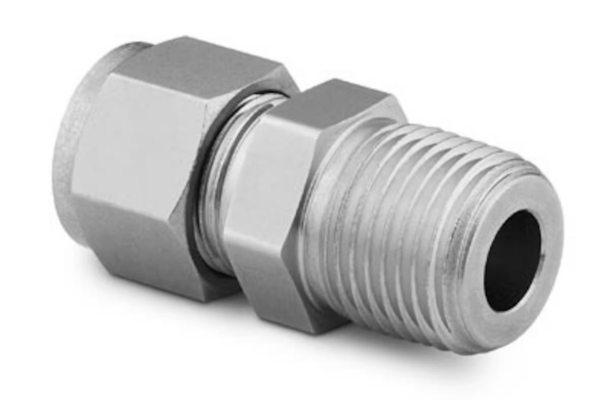
For a branch, use a union tee; for a straight joint, a union connector. Where the elbow must also connect to a threaded port, male and female elbows (tube × male thread or tube × female thread) are available in the same designs as the male connector.
Choosing the Design
Double ferrule union elbows are used for critical and high-pressure instrumentation; single ferrule for general service; DIN 2353 bite type elbows for metric hydraulic systems. Use the same design throughout a tubing system so that ferrules, nuts and bodies remain matched.
Applications & Industries
- Instrument tubing in oil, gas and petrochemical plants
- Analyser shelters and sample systems
- Hydraulic and pneumatic control circuits
- Chemical injection skids and offshore control lines
- Machinery lubrication and cooling tubing
Tube selection matters as much as the fitting. For stainless steel compression fittings, use fully annealed seamless or welded-and-drawn tubing of suitable hardness, with a wall thickness chosen for the working pressure. Union elbows are often used at the end of a tube tray or support run to bring tubing down to an instrument, and are supplied in quantity with matching connectors and tees for complete hook-ups.
When ordering, give the tube OD, fitting design and material grade — for example 12 mm union elbow, double ferrule, SS 316L. See all tube fittings.
Testing, Inspection, Marking & Packing
Union elbows are produced under our quality assurance process:
- Material verified by PMI testing, with full traceability
- Dimensional inspection of seats, bores, threads and centre-to-end dimensions
- Pressure testing on request
- Marking with material grade and heat code
Supplied with EN 10204 3.1 mill test certificates; EN 10204 3.2 certificates and third-party inspection on request.
Fittings are capped and bagged to keep ports clean, then boxed and packed in seaworthy wooden cases for export; marking, tagging and packing to your specification are available on request.
Why Choose Raaj Fittings for Union Elbows?
Raaj Sagar Steels has supplied piping components since 2003 and today manufactures tube fittings at two plants in India for buyers in the Middle East, Europe and the Americas.
- Manufactured in-house — Union elbows are made in our own plants, so material, dimensions and delivery stay under our control.
- Ready stock, short lead times — common sizes and grades are held in stock for prompt dispatch; other sizes, grades and specials are manufactured to order.
- Certified quality — ISO 9001:2015, ISO 14001:2015 and ISO 45001:2018 certified; PED 2014/68/EU supply available, and NACE MR0175 / ISO 15156 material on request.
- 100% material verification — PMI testing on incoming material and EN 10204 3.1 mill test certificates with every order; 3.2 certificates on request.
- Third-party inspection ready — we regularly work with SGS, Bureau Veritas, TÜV and DNV.
- Export documentation — MTCs, certificates of origin, packing lists and inspection reports to suit projects in the GCC, Europe and the Americas.
- Export packing — seaworthy packing with end and face protection, and packing to your specification on request.
- Fast response — our team replies to enquiries within one business day.
Union Elbows — FAQs
A union elbow is a 90° tube fitting with a compression end on each leg, joining two tubes of the same OD at a right angle.
When space is too tight for a bend, when the tube is hard to bend, or when you need a break point for maintenance.
Double ferrule, single ferrule and DIN 2353 bite type union elbows.
Yes. Elbows with one tube end and one male or female threaded end are available in the same designs and materials.
Metric tube ODs from 3 mm to 25 mm (4 mm to 42 mm in DIN 2353) and imperial ODs from 1/8" to 1".
Yes. Double ferrule union elbows in SS 316L are widely used on instrument air, nitrogen, natural gas and calibration gas lines, where a gas-tight, vibration-resistant joint is required.
Yes. We supply union elbows for projects under the European Pressure Equipment Directive (PED 2014/68/EU), with EN 10204 3.1 certificates as standard and 3.2 on request. NACE MR0175 / ISO 15156 compliant material is available for sour service in the Middle East and the Americas.