Choosing the right pipe fittings looks simple until you open a piping specification. Buttweld or socket weld? Class 3000 or Class 6000? SCH 40 or SCH 80? ASTM A234 WPB or A403 WP316L? A wrong choice can mean a joint that leaks, a fitting that corrodes in months, or a delay while non-compliant material is replaced.
This guide walks through the decisions in the order an engineer or buyer makes them: the type of connection, the size and pressure, the material, the wall thickness or class, the standard, and the documentation. At the end you will find a checklist you can use for every enquiry.
Step 1: Choose the Connection Type
Most industrial piping uses one of four families of fittings. Each suits a different range of sizes, pressures and installation conditions.
Buttweld Fittings (ASME B16.9)
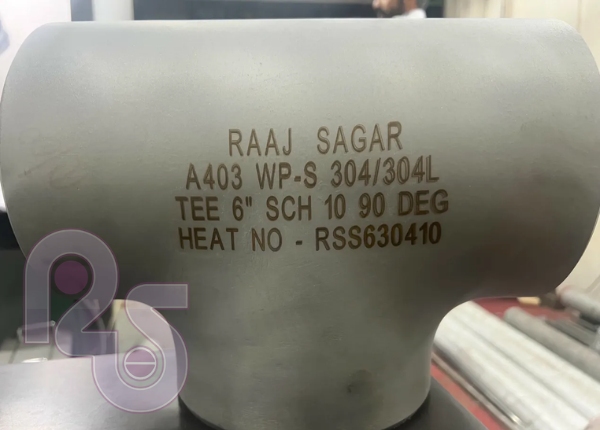
Buttweld fittings — elbows, tees, reducers, caps and stub ends — are welded to the pipe with a full-penetration butt weld. The joint is as strong as the pipe, can be radiographed, and leaves a smooth bore with no crevice. They are the standard choice for process piping from 2" upwards and for high-pressure, high-temperature and hazardous service.
Socket Weld Fittings (ASME B16.11)
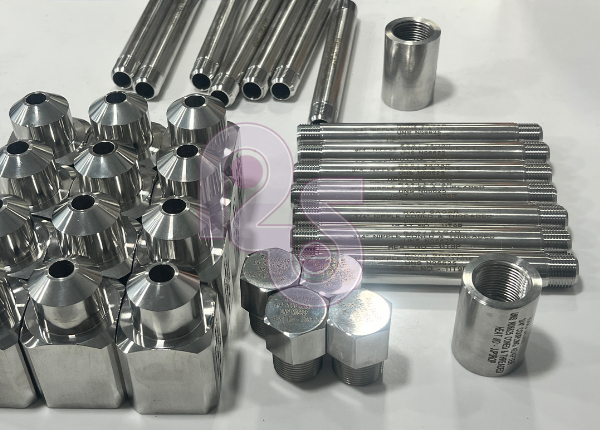
Socket weld fittings have a recess into which the pipe is inserted and fillet-welded. They are compact, easy to align and suitable for high pressures in small sizes, typically up to 2" and occasionally 3". The small gap between pipe and socket can trap fluid, so they are avoided where crevice corrosion is a risk. See our forged fittings range.
Threaded Fittings (ASME B16.11)
Threaded fittings screw onto pipe with NPT or BSP threads. They need no welding, which makes them useful in areas where hot work is restricted, on galvanised pipe and on utility lines. Threads reduce the pipe wall and can leak under vibration or thermal cycling, so threaded joints are normally limited to smaller sizes and less critical service.
Tube Fittings
For instrumentation and hydraulic tubing — usually 3 mm to 25 mm or 1/8" to 1" OD — compression tube fittings are used instead of pipe fittings. Double ferrule fittings give a gas-tight, vibration-resistant seal for critical instrument lines, while DIN 2353 bite type fittings are common in metric hydraulic systems.
Step 2: Match Size and Pressure
As a general rule of thumb:
- Above 2" — buttweld fittings for nearly all process service.
- ½" to 2" — socket weld fittings for process and high-pressure lines; buttweld where the specification requires it.
- Up to 2" utility lines — threaded fittings where permitted.
- Instrument and hydraulic tubing — compression or bite type tube fittings.
Your piping class, written under a code such as ASME B31.3 (process piping), B31.1 (power piping) or B31.4 / B31.8 (pipelines), will state which connection types are allowed for each size and service. Always follow it.
Step 3: Select the Material
The fluid, temperature and environment decide the material. The fitting material must also be compatible with — and weldable to — the pipe.
| Service | Typical buttweld grade | Typical forged grade |
|---|---|---|
| General carbon steel service | ASTM A234 WPB | ASTM A105 |
| Low temperature (to -46 °C) | ASTM A420 WPL6 | ASTM A350 LF2 |
| High-temperature steam and refinery | ASTM A234 WP11 / WP22 / WP91 | ASTM A182 F11 / F22 / F91 |
| Corrosive, chemical, food and pharma | ASTM A403 WP304L / WP316L | ASTM A182 F304L / F316L |
| Seawater and offshore | Duplex 2205, super duplex 2507 | ASTM A182 F51 / F53 / F55 |
| Severe acids and sour service | Inconel 625, Hastelloy C276, Monel 400 | Same nickel alloys |
For hydrocarbon service containing hydrogen sulphide, specify materials compliant with NACE MR0175 / ISO 15156, which limits hardness and sets other requirements to resist sulphide stress cracking.
Step 4: Wall Thickness and Pressure Class
Buttweld fittings are ordered by schedule to match the pipe — SCH 5S and 10S for light-wall stainless, SCH 40 / STD and SCH 80 / XS for most process lines, and SCH 160 or XXS for high pressures. The fitting must have the same wall thickness as the pipe it is welded to, so the bores line up.
Forged fittings are ordered by pressure class, which ASME B16.11 links to a pipe schedule. For socket weld fittings, Class 3000 suits SCH 80 pipe, Class 6000 suits SCH 160 and Class 9000 suits XXS. For threaded fittings, Class 2000 suits SCH 80, Class 3000 suits SCH 160 and Class 6000 suits XXS. Choosing the class from the schedule ensures the fitting is at least as strong as the pipe.
Step 5: Pick the Right Fitting Shape
- Changing direction — 90° long radius elbows (R = 1.5D) are the default; short radius elbows only where space is tight; 45° elbows for offsets.
- Branching — equal tees and reducing tees; laterals where turbulence must be minimised.
- Changing size — concentric reducers in vertical lines; eccentric reducers flat-on-top on pump suctions and flat-on-bottom where lines must drain.
- Closing a line — caps for permanent closures, blind flanges where access is needed.
- Removable joints — flanges, unions or stub ends with lap joint flanges.
Step 6: Standards and Documentation
State the dimensional standard (ASME B16.9, B16.11, MSS SP-43, EN 10253 or DIN), the material specification and grade, and the end preparation (bevel to ASME B16.25, NPT or BSP threads). Ask for EN 10204 3.1 mill test certificates as a minimum; projects with stricter quality requirements specify 3.2 certificates witnessed by a third-party inspector. For Europe, check whether PED compliance is needed; for Indian boiler applications, IBR certification.
Buyer's Checklist
- Fitting type and shape (e.g. 90° LR elbow, reducing tee).
- Size(s) — NPS or DN, run × branch for tees, large × small for reducers.
- Connection — buttweld, socket weld, threaded (NPT / BSP) or tube OD.
- Schedule or pressure class.
- Material specification and grade, plus any NACE or impact-test requirement.
- Seamless or welded construction.
- Dimensional standard.
- Quantity and required delivery date.
- Certificates, inspection and packing requirements.
Frequently Asked Questions
When should I use socket weld instead of buttweld fittings?
Socket weld fittings suit small-bore lines, usually 2" and below, where their compact size and easy alignment save time. Buttweld fittings are preferred above 2", for severe cyclic service and where crevice corrosion is a concern.
Do fittings have to be the same schedule as the pipe?
Buttweld fittings should match the pipe wall thickness so the bores align after welding. Forged fittings are selected by pressure class, which ASME B16.11 relates to the pipe schedule.
Are seamless fittings better than welded fittings?
Seamless fittings have no weld seam and are preferred for high-pressure, critical and sour service. Welded fittings, with radiographed seams, are economical and widely used in larger sizes and general service.
What certificates should I ask for?
EN 10204 3.1 mill test certificates as a minimum, confirming chemistry and mechanical properties against the heat number. Request 3.2 certificates if your project requires third-party witnessing.
Get Expert Help With Your Next Order
The right fitting is the one that matches your pipe, your piping code and your service conditions — in material, wall thickness, connection and documentation. Raaj Fittings manufactures buttweld, forged and tube fittings in stainless steel, duplex, nickel alloys, carbon and alloy steel for buyers across the Middle East, Europe and the Americas. Send us your requirement and our team will confirm the right specification and quote within one business day.