ASTM A403 buttweld tees are among the most frequently ordered stainless steel fittings in process plants, yet they are also among the most often mis-specified. A purchase order that says only "SS 316 tee, 4 inch" leaves the supplier to guess the class, wall thickness, construction and standard — and the fitting that arrives may not pass inspection.
This guide explains what ASTM A403 covers, how its classes and grades work, which schedules apply to stainless tees, and how to write a description that gets you exactly the tee you need.
What Is ASTM A403?
ASTM A403 is the material specification for wrought austenitic stainless steel piping fittings — elbows, tees, reducers, caps, crosses and stub ends — intended for pressure piping. It sets the chemical composition, mechanical properties, heat treatment, testing and marking of the fitting material. It does not set the shape or dimensions; those come from a dimensional standard such as ASME B16.9 (or MSS SP-43 for light-wall fittings). A correctly specified tee always quotes both.
WP and CR Classes
ASTM A403 divides fittings into two general classes:
- WP — fittings made to the dimensions of ASME B16.9 (and related standards) for pressure piping. Most process piping specifications call for WP fittings.
- CR — fittings made to the lighter dimensional and testing requirements of MSS SP-43, typically for low-pressure, corrosion-resistant service.
Within the WP class, a suffix shows how the fitting was made and what examination its welds received:
- WP-S — seamless construction.
- WP-W — welded construction, with welds examined as the specification requires.
- WP-WX — welded, with all welds radiographed.
- WP-WU — welded, with all welds ultrasonically examined.
So a fitting marked WP316L-S is a seamless 316L fitting, while WP316L-WX is welded with fully radiographed welds. Many critical-service specifications require seamless tees in smaller sizes and WX in larger welded sizes; check your piping class.
Common Grades
| Grade | Typical use |
|---|---|
| WP304 / WP304L | General corrosion resistance; water, food, dairy and mild chemicals |
| WP316 / WP316L | Better resistance to chlorides and acids; chemical, pharmaceutical and marine service |
| WP316H / WP304H | Higher carbon for strength at elevated temperatures |
| WP317L | Higher molybdenum for aggressive acid service |
| WP321 | Titanium-stabilised; resists sensitisation at sustained high temperatures |
| WP347 | Columbium-stabilised; heat exchangers and high-temperature piping |
The "L" grades have low carbon, which reduces the risk of sensitisation and intergranular corrosion after welding. Dual-certified fittings such as WP304/304L or WP316/316L meet both the strength of the standard grade and the low carbon of the L grade, and are widely accepted for either.
Schedules for Stainless Tees
A buttweld tee must have the same wall thickness as the pipe it joins. Stainless steel piping commonly uses the "S" schedules:
- SCH 5S and 10S — light wall, for low-pressure, utility and sanitary lines.
- SCH 40S — standard wall for most process service.
- SCH 80S — extra-strong wall for higher pressures and small-bore lines.
SCH 40S has the same wall thickness as SCH 40 up to 10", and SCH 80S the same as SCH 80 up to 8"; above those sizes the S schedules are thinner — another reason to state the schedule exactly as it appears on the pipe specification.
Equal and Reducing Tees
An equal tee has all three ends the same size; ASME B16.9 gives the same centre-to-end dimension for the run and the branch (about 105 mm for a 4" tee). A reducing tee has a smaller branch and is written run × run × branch — for example 6" × 6" × 4". Where the branch is far smaller than the run, a branch outlet fitting may be more economical. For two branches at one point, a buttweld cross is available.
Heat Treatment and Surface Finish
ASTM A403 fittings are supplied in the solution-annealed condition, which dissolves carbides and restores full corrosion resistance after forming. Fittings are then pickled and passivated to remove scale and leave a clean, passive surface. For hygienic or high-purity service, additional internal finishing can be specified.
Testing and Inspection
Beyond the chemical and tensile tests required by ASTM A403, buyers commonly add project-specific checks: positive material identification (PMI) of every fitting, dimensional inspection against ASME B16.9 tolerances, radiography or ultrasonic testing of welds, and intergranular corrosion testing to ASTM A262 for critical chemical service. State any of these on the order, together with whether a third-party inspector will witness them, so they are built into the production plan rather than added later.
Marking
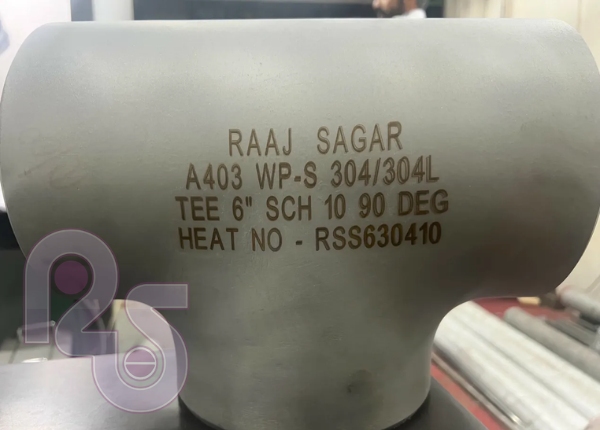
Each tee should carry the manufacturer's mark, the material grade with class suffix (e.g. WP316L-S), the size, schedule and heat number, so it can be traced back to its mill test certificate. Missing or unclear marking is a common reason for rejection at receipt inspection.
How to Specify an ASTM A403 Tee
A complete description includes:
- Fitting — equal tee or reducing tee (with run × branch sizes).
- Size and schedule — e.g. 4" SCH 10S.
- Material and class — e.g. ASTM A403 WP316L-S or WP316L-WX.
- Dimensional standard — ASME B16.9 (or MSS SP-43 for CR class).
- End preparation — bevelled to ASME B16.25.
- Certificates — EN 10204 3.1 (or 3.2), plus any project-specific tests such as intergranular corrosion testing.
Example: Tee, equal, 4" SCH 10S, ASTM A403 WP316L-S, ASME B16.9, bevelled ends to ASME B16.25, EN 10204 3.1 certificate.
Frequently Asked Questions
What is the difference between ASTM A403 and ASME B16.9?
ASTM A403 is the material specification — chemistry, properties, heat treatment and marking. ASME B16.9 is the dimensional standard — shape, size and tolerances. A buttweld tee should be ordered to both.
What does WP316L-S mean?
WP is the class for pressure-piping fittings to ASME B16.9, 316L is the grade, and S means seamless construction.
Can I use a 316 tee with 316L pipe?
For welded systems, low-carbon 316L or dual-certified 316/316L is preferred to avoid sensitisation at the welds. Follow your piping specification.
Are welded A403 tees acceptable?
Yes, when the specification allows them. Welded tees are made in classes WP-W, WP-WX or WP-WU, depending on the weld examination required; WX (fully radiographed) is common for critical service.
Order ASTM A403 Tees With Confidence
Getting the class, grade, schedule and standard right on the purchase order is the easiest way to avoid rejected material and delays. Raaj Fittings manufactures ASTM A403 equal and reducing tees in seamless and welded construction, in grades from 304L to 347 and schedules from 5S to 80S, with full certification. See our buttweld fittings range or send us your enquiry for a fast quotation.