If you have ever reviewed a piping material requisition, a datasheet or a purchase order for industrial flanges, you will have met designations like ASME B16.5 Class 300, "ANSI flange" or DIN 2633 PN16. These are not arbitrary labels. They are shorthand for a precise set of engineering rules — governing dimensions, pressure ratings, materials, facing types and testing — that determine whether a flange will seal safely in service or leak.
Flange standards exist because pipelines do not stay within one factory, one country or one engineering specification. A flange manufactured in India must mate perfectly with a valve made in Italy and a pump made in the USA, on a project designed in the UK and built in the Gulf. Only a shared standard makes that possible.
This guide explains what flange standards are, how the major systems — ANSI, ASME B16.5, EN 1092-1 and DIN — work, where they differ, how pressure classes compare with PN ratings, and what to put on a purchase order so the flanges you receive are the flanges you need.
What Is a Flange Standard?
A flange standard is a published document that fixes everything needed to make flanges interchangeable and safe:
- Dimensions — outside diameter, thickness, bolt circle, number and size of bolt holes, hub dimensions and bore.
- Pressure–temperature ratings — the maximum working pressure for each material at each temperature.
- Facings — raised face, flat face, ring type joint and their surface finish.
- Materials — which forging, plate and casting specifications may be used.
- Tolerances, marking and testing — how accurate the flange must be, how it is identified and how it is checked.
Two flanges built to the same standard, size and rating will bolt together and seal with the right gasket, regardless of who made them.
ANSI vs ASME: The Same Flange, Two Names
Buyers often ask whether an "ANSI flange" is different from an "ASME flange". In practice it is the same thing. The American Society of Mechanical Engineers (ASME) writes and publishes the B16 flange standards; the American National Standards Institute (ANSI) accredits standards-writing bodies and approves their documents as American National Standards. Older drawings and specifications refer to "ANSI B16.5", and the name stuck in everyday purchasing. Today the correct reference is ASME B16.5.
The ASME Flange Family
Several ASME standards cover different flange types and sizes:
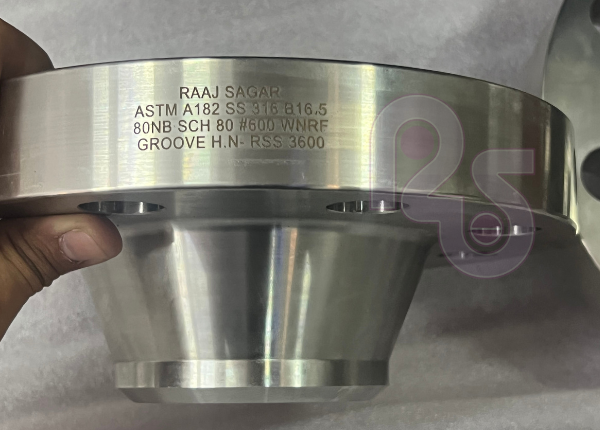
- ASME B16.5 — pipe flanges and flanged fittings from NPS ½" to 24", in pressure Classes 150, 300, 400, 600, 900, 1500 and 2500. It covers weld neck, slip on, socket weld, threaded, lap joint and blind flanges.
- ASME B16.47 — large-diameter flanges from NPS 26" to 60", in two series that are not interchangeable: Series A (formerly MSS SP-44) and Series B (formerly API 605).
- ASME B16.36 — orifice flanges for flow measurement, from Class 300.
- ASME B16.48 — line blanks: spectacle blinds, paddle blinds and spacers.
What a Pressure Class Really Means
A common misunderstanding is that "Class 300" means 300 psi. It does not. The class is a rating designation; the actual allowable pressure depends on the flange material and the operating temperature. ASME B16.5 groups materials (for example, carbon steel ASTM A105 in one group, 316 stainless steel in another) and gives a pressure–temperature table for each group. A Class 300 carbon steel flange is rated at about 51 bar at ambient temperature, but considerably less at 400 °C. Always check the table for your material and design temperature — not just the class number.
European Standards: DIN and EN 1092-1
In Europe, flanges were historically made to German DIN standards — for example DIN 2633 (weld neck, PN16) or DIN 2576 (plate slip-on, PN10). These have been replaced by the harmonised European standard EN 1092-1, which covers steel flanges from PN 2.5 to PN 400 and gives each flange type a number: Type 01 plate flange, Type 05 blind flange, Type 11 weld neck, and so on. Many specifications still quote DIN numbers, and both remain widely used across Europe, the Middle East and Asia.
European flanges are rated by PN (pression nominale) — PN6, PN10, PN16, PN25, PN40, PN63, PN100 and above. Unlike an ASME class, the PN number roughly corresponds to the allowable pressure in bar for the reference material at ambient temperature, with derating at higher temperatures.
Can ASME and EN/DIN Flanges Be Mixed?
Generally, no. ASME and EN/DIN flanges of the same nominal size usually have different outside diameters, bolt circles, bolt-hole sizes and numbers of bolts, and they use different bolt standards (inch versus metric). A few size and rating combinations come close, but they should never be assumed to match. Where a European valve must connect to ASME piping, the solution is an adapter spool or a valve ordered with the correct flange standard.
For rough comparison, engineers often relate the systems as follows:
| ASME class | Approximate PN equivalent |
|---|---|
| Class 150 | PN 20 |
| Class 300 | PN 50 |
| Class 600 | PN 100 |
| Class 900 | PN 150 |
| Class 1500 | PN 250 |
| Class 2500 | PN 420 |
These equivalents describe pressure capability only. They do not make the flanges dimensionally interchangeable.
Other Standards You May Meet
- BS 4504 — the former British standard, now superseded by EN 1092-1.
- JIS B2220 — Japanese flanges rated 5K, 10K, 16K, 20K and above, common on Asian-built equipment.
- IS 6392 — Indian standard pipe flanges.
- API 6A / 6B / 6BX — wellhead and Christmas-tree flanges for upstream oil and gas, with ring joint facings.
- MSS SP-44 — steel pipeline flanges, now largely incorporated into ASME B16.47 Series A.
Facings and Gaskets
The standard also defines the sealing face. Raised Face (RF) is the most widely used, with spiral wound or flat gaskets. Flat Face (FF) is used against cast iron or non-metallic equipment. Ring Type Joint (RTJ) faces carry a machined groove for an oval or octagonal metal ring and are favoured at high pressures and in oil and gas production. The gasket must match both the facing and the standard — an EN gasket will not suit an ASME flange.
How to Specify Flanges Correctly
A complete flange description leaves nothing to interpretation. Include:
- Flange type — weld neck, slip on, blind, socket weld, threaded, lap joint.
- Nominal size — NPS or DN.
- Standard — ASME B16.5, B16.47 Series A or B, EN 1092-1 type, DIN number, etc.
- Pressure class or PN rating.
- Facing and finish — RF, FF or RTJ, with ring number for RTJ.
- Bore or pipe schedule for weld neck and socket weld flanges.
- Material specification and grade — for example ASTM A182 F316L or ASTM A105N.
- Testing and documentation — EN 10204 3.1 or 3.2 certificates, NACE MR0175 requirements, third-party inspection.
For example: Weld neck flange, 6" Class 300 RF, ASME B16.5, bore to SCH 40, ASTM A182 F316L, EN 10204 3.1.
Frequently Asked Questions
Is an ANSI flange the same as an ASME flange?
Yes. ASME publishes the B16.5 standard and ANSI approves it as an American National Standard. "ANSI flange" is the older, informal name for an ASME B16.5 flange.
Does Class 150 mean the flange is rated at 150 psi?
No. The class is a rating designation. The allowable pressure depends on the material group and temperature in the ASME B16.5 tables; a Class 150 carbon steel flange is rated at about 19.6 bar at ambient temperature.
Can I bolt a DIN PN16 flange to an ASME Class 150 flange?
Not reliably. The bolt circles, bolt-hole numbers and sizes differ in most sizes. Use flanges to the same standard, or an adapter spool between the two systems.
Which standard covers flanges above 24 inches?
ASME B16.47 covers NPS 26" to 60", in Series A and Series B. The two series have different dimensions and are not interchangeable, so the series must always be stated.
Getting Flanges That Fit First Time
Flange standards are what allow equipment from different countries and suppliers to come together safely on one project. Specifying the right standard, rating, facing and material — and checking the pressure–temperature table for your service — avoids leaks, rework and delays on site.
Raaj Fittings manufactures flanges to ASME B16.5, B16.47, B16.36, B16.48, EN 1092-1, DIN, BS, JIS and IS standards in stainless steel, duplex, nickel alloys, carbon and alloy steel. Explore our full flange range or send us your requirement for a quotation within one business day.